
No mystery pricing
HVAC Cost Guide for Gallatin, TN
What HVAC work typically costs in Middle Tennessee, what drives the price up or down, and how to spot a quote that doesn't add up.
(615) 412-2495- Typical TN price ranges
- Repair-vs-replace framework
- Red flags to watch for
Typical ranges
What HVAC work costs in Middle Tennessee
The numbers below are typical ranges we see in the Gallatin area, not quotes. Your exact price depends on the diagnosis, your system's size and age, and the scope of work. But these ranges give you a reality check before anyone hands you a number.
| Job | Typical range | Notes |
|---|---|---|
| Diagnostic visit | $75–$150 | Often credited toward the repair if you proceed |
| Capacitor / contactor replacement | $150–$400 | Among the most common AC repairs |
| Thermostat replacement (installed) | $150–$500 | Smart thermostats cost more; wiring fixes extra |
| Blower motor replacement | $400–$800 | Variable-speed motors run higher |
| Refrigerant leak repair + recharge | $300–$1,000+ | Older R-22 systems cost significantly more per pound |
| Compressor replacement | $1,500–$2,500 | Often the tipping point toward replacement |
| Furnace replacement | $4,500–$9,000 | Depends on size, efficiency, and venting work |
| Full AC or heat pump system replacement | $7,000–$14,000 | Size, efficiency rating, and ductwork drive this range |
| Ductwork repair / replacement | $1,500–$5,000+ | Sealing is cheaper; full redesign costs more |
For the only number that matters, your number, request a diagnostic visit. You'll get it in writing before any work starts, per our service process.
The big decision
Repair or replace? How to think about it
This is the question behind almost every expensive HVAC decision. Here's the framework honest techs actually use:
- Age of the system. Past 12–15 years, major components are living on borrowed time. Under 10 with a simple failure, repair usually wins.
- The 50% rule. If the repair costs more than about half of a replacement and the system is over 10 years old, replacement deserves serious consideration.
- Repair history. One repair in five years is normal. Three repairs in two years is a pattern, and patterns get expensive.
- Efficiency. A 15-year-old system can cost hundreds more per year to run than a modern one. Factor the energy savings into the math, and check ENERGY STAR's guidance on efficient heating and cooling equipment.
- Comfort problems. If some rooms never get comfortable no matter what, a new system alone may not fix bad ductwork. Fix the ducts first, then decide.
- Refrigerant type. Systems running R-22 (phased out) face sky-high refrigerant costs. A leak on an R-22 system often tips the scales toward replacement.
Our longer walkthrough, Repair or Replace: How to Decide, works through real scenarios with real numbers.
Why quotes differ
What affects the price
Two quotes for "a new AC" can differ by thousands and both be legitimate, because they may describe different jobs. Here's what moves the number:
- System size and efficiency. Bigger homes need bigger systems; higher SEER2 ratings cost more upfront and save more monthly.
- Ductwork condition. Leaky or undersized ducts must be addressed, or the new system underperforms from day one.
- Electrical and venting. Panel upgrades, new line sets, or venting changes add real cost.
- Permits and inspections. Legitimate jobs include them. Suspiciously cheap quotes often don't.
- Warranty terms. Parts-only vs. parts-and-labor warranties are very different products. Ask which you're getting.
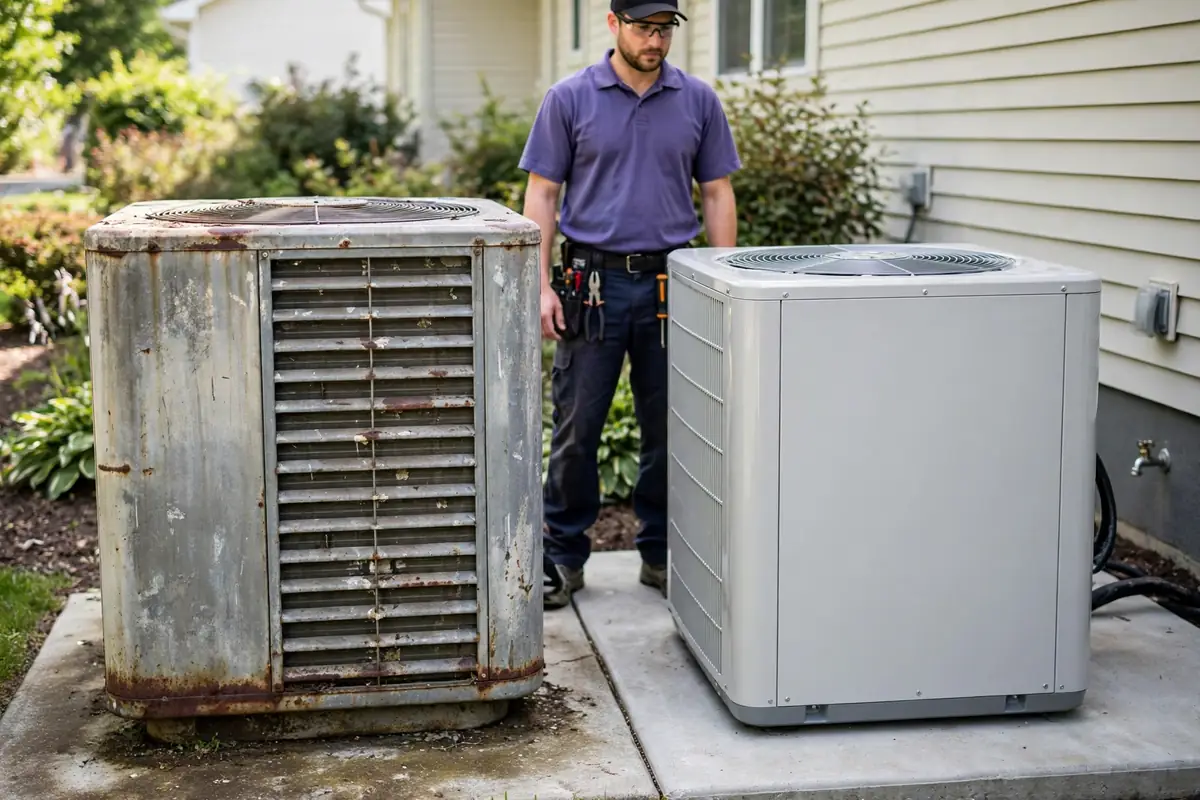
Protect yourself
Red flags: stories homeowners share
The stories below aren't ours. They're stories shared online by homeowners across forums and social media, and they follow the same patterns we warn every customer about:
- The $13,000 replacement quote for a system that a second tech repaired for under $200. When the first quote skips straight to replacement with no repair option shown, get another opinion.
- Over $1,000 charged for four pounds of refrigerant with no leak search performed. Refrigerant isn't consumed in normal operation. If it's low, there's a leak, and topping it off without finding it means you'll pay again next year.
- The warranty surprise: a repair "covered under warranty" that still cost $1,700 because the warranty didn't include labor. Always ask whether a warranty covers parts only or parts and labor.
- The disappearing discount: "this price is only good if you sign today." Legitimate quotes don't expire at midnight.
A fair quote is written, itemized, and explains the why behind the what. It shows you repair and replacement side by side when both are realistic. And the company behind it welcomes comparison. If you have a quote that feels off, bring it to us for a second opinion. We'd rather earn your trust on a $150 diagnostic than watch you overpay someone else $10,000.
Common questions
Cost questions, answered honestly
A fair quote is written and itemized, explains what is being fixed and why, and shows you both repair and replacement options when both are realistic. Be cautious of vague one-line prices, pressure to sign on the spot, or quotes that skip straight to replacement without a repair option. Comparing two or three written quotes is the fastest way to calibrate what fair looks like in Gallatin.
Typical ranges in Middle Tennessee: a diagnostic visit runs $75 to $150, common repairs like capacitors or contactors run $150 to $400, blower motors $400 to $800, and refrigerant leak repairs $300 to $1,000 or more depending on the refrigerant type. Major work like a compressor replacement can run $1,500 to $2,500. These are typical ranges, not quotes; your exact price depends on the diagnosis.
Because quotes often describe different jobs. One company may quote a basic single-stage system reusing old ductwork, while another quotes a two-stage system with duct modifications, new thermostat, and permits. Always compare the equipment specs, scope of work, and warranty terms line by line, not just the bottom-line number.
It can be. Dramatically low bids sometimes mean undersized equipment, skipped permits, no load calculation, reused failing components, or a warranty that exists only on paper. The cheapest install is expensive if it fails early or never heats and cools properly. Ask what is included and what is not.
Yes, especially for jobs over a few thousand dollars. Two or three written quotes will show you the real market range and expose outliers in either direction. Any honest company welcomes the comparison, and we are happy to review another company's quote with you as a second opinion.
Get your number in writing.
One diagnostic visit, honest written options, zero pressure. That's the deal.
(615) 412-2495 Call Gallatin HVAC Repair Pro