Gallatin's heating & air pros — serving Sumner County, TN  ·  Call (615) 412-2495
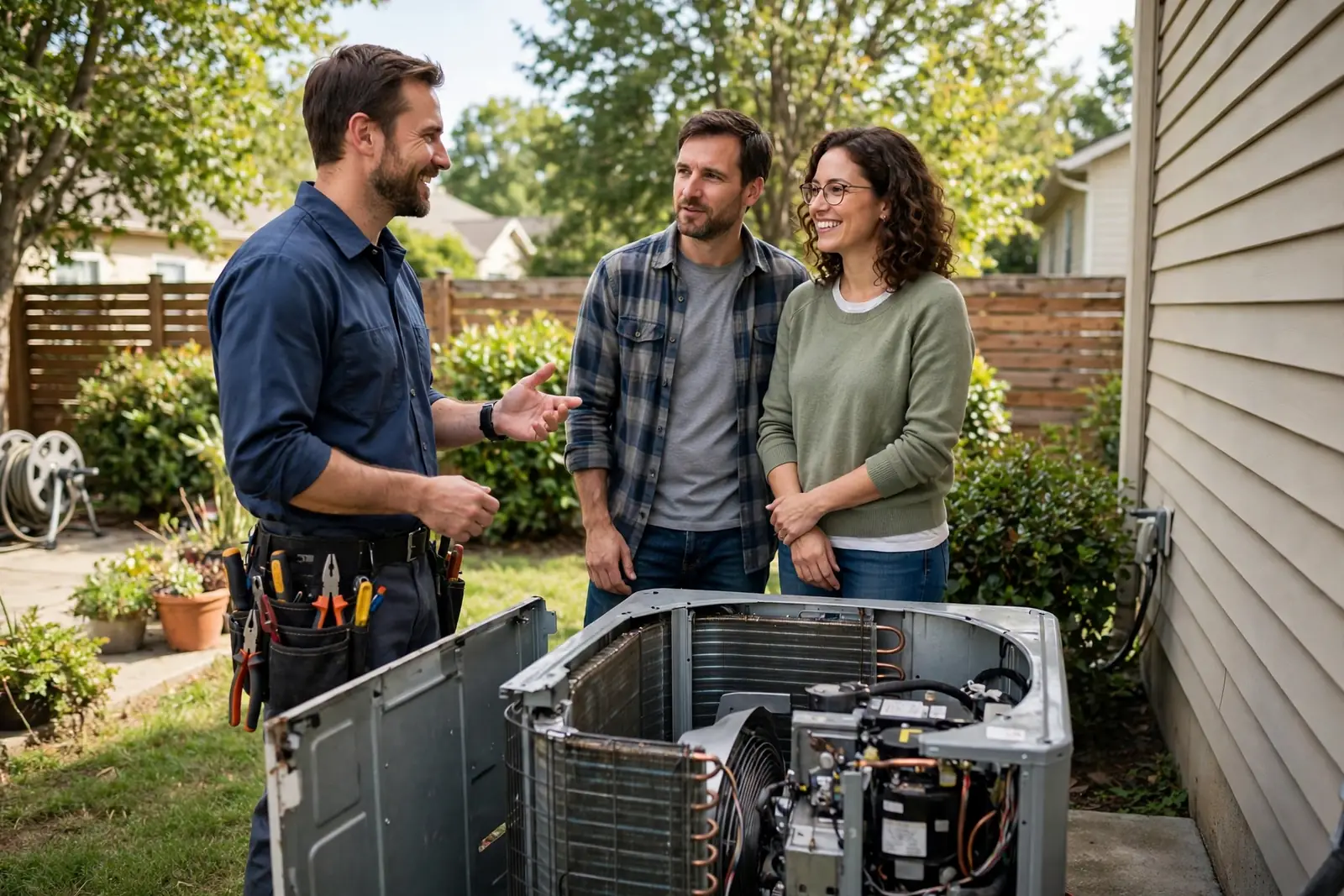
HVAC technician discussing repair and replacement options with homeowners beside their outdoor unit

Big decision guide

Should You Repair or Replace Your HVAC System?

The framework we use with our own neighbors in Gallatin: age, efficiency, and cost, weighed honestly. No pressure, no scare tactics.

(615) 412-2495
  • The age, efficiency, and cost framework
  • Why install quality beats brand
  • Decide on your schedule, not in a panic

The short answer

Repair when it is young and the fix is small; replace when it is old and the fix is big

Every homeowner with an aging system eventually faces the same question, usually on the hottest or coldest day of the year. A technician stands in your hallway, your system is down, and someone is quoting you $1,500 for a repair or $9,400 for a full replacement. It feels like a trap either way. It is not, as long as you have a framework instead of a feeling.

Here is ours, the same one we walk through with customers from Foxland Harbor to Grandview Estates. Three questions, answered honestly, tell you most of what you need to know.

The framework

Three questions that decide it

1. How old is the system?

Most air conditioners and heat pumps last 12 to 15 years in Middle Tennessee; furnaces often reach 15 to 20. Under 10 years old, repair is usually the smart money. Past 12 to 15 with a major failure, replacement deserves a serious look, because the rest of the components are the same age as the one that just failed.

2. What does the repair cost relative to replacement?

The common rule of thumb: if a repair costs more than about half the price of a new system, replacement usually wins. A $200 contactor on a 9-year-old unit is a no-brainer repair. A $1,800 compressor job on a 14-year-old unit is money you will likely spend again soon on the next aging part.

3. How efficient is the current system?

A 15-year-old unit in 37066 has run through a lot of humid Gallatin summers. If your summer electric bills have been climbing and the system uses an older refrigerant or a low efficiency rating, a new system can cut cooling costs noticeably. Efficiency alone rarely justifies replacement, but it tips close calls.

Two out of three pointing toward replacement is a strong signal. All three pointing that way is about as clear as this decision gets.

The honest math

The $1,500 repair vs. $9,400 replacement debate

This is the real-world scenario homeowners argue about online, and the numbers are worth taking seriously. Say your 13-year-old system needs a $1,500 repair. A new system costs around $9,400. Which is smarter?

Think of it as buying years. If the repair buys you three more years, that is $500 per year, which beats $9,400 for a new system that lasts 15 years (about $625 per year before energy savings). But that math only works if the repair actually buys you those years. A 13-year-old system that needed a major repair this year is a good candidate to need another one next year, and the year after. Homeowners who track it often land on a mental model of $750 to $1,000 per year for an aging system in repairs and extra energy costs. Once you are spending that, replacement stops being the expensive option.

Our position at Gallatin HVAC Repair Pro: we will happily do the $1,500 repair if the system has life left, and we will tell you plainly when we think it does not. A repair-first company that also installs new systems has no reason to push you either way, and that is exactly the point. For detailed Tennessee pricing context, our HVAC cost guide lays out realistic ranges.
What actually matters

Installation quality matters more than brand

Ask any group of experienced techs what matters most in a new system and you will hear the same consensus: the installation matters more than the brand on the box. Most major manufacturers build solid equipment with similar core components. What separates a system that runs 15 quiet years from one that struggles for 10 is proper sizing through a real load calculation, careful ductwork connections, correct refrigerant charge, and thorough commissioning and testing.

That is why three quotes within a few hundred dollars of each other should not be decided on price. Compare what is behind the number: Did anyone measure your home and run a load calculation, or just swap in the same size? What are the parts and labor warranty terms? Who pulls the permit and who tests the system after installation? The answers to those questions are worth more than any brand badge. ENERGY STAR's guidance on when to replace heating and cooling equipment reinforces the same point about proper sizing and installation.

When you are ready to talk specifics, our pages on AC installation and heating installation describe what a proper Gallatin installation includes.

Timing

Replace on your schedule, not in a panic

The single best piece of advice we can give: if your system is over 12 years old, start planning its replacement before it dies. Get quotes in the spring or fall when contractors have time to do the job right and you have time to think. Compare options without sweat running down your back or your pipes at risk.

Emergency replacements are where bad decisions happen. The system dies during a heat wave, every contractor is booked solid, and you say yes to the first available quote at the worst possible price. Planning ahead turns a $9,400 surprise into a considered purchase you might even time with seasonal promotions or available rebates.

In the meantime, regular HVAC maintenance is the cheapest way to stretch the years you have left. A tune-up will not make a 16-year-old system young again, but it will catch the small problems that turn into the big repair bills that force the decision early. You can also read more about how we think through options with customers on our home page.

Common questions

Repair vs. replace FAQs

At 12 years, it depends on the repair cost and the system's condition. A minor repair on an otherwise healthy unit can be worthwhile, but a major repair costing close to half the price of replacement usually points toward replacing, since the rest of the aging components are still 12 years old.

Compare what is actually included: equipment efficiency ratings, warranty terms on parts and labor, whether a load calculation was done, and how the company handles permits and commissioning. The cheapest quote with thin warranty coverage is rarely the best value.

Installation quality matters more. Most major brands use similar core components, and a properly sized, carefully installed mid-tier system will outperform a premium unit installed sloppily. Ask contractors about their installation process, not just the badge.

Get at least two or three itemized quotes for comparable equipment and scope, and be wary of quotes given without a home visit or load calculation. A fair quote explains the equipment, the work included, warranty terms, and the reasoning in plain language.

Facing the repair-or-replace decision?

We will give you both options in writing and our honest recommendation.

(615) 412-2495 Call Gallatin HVAC Repair Pro
Call (615) 412-2495 Get Service